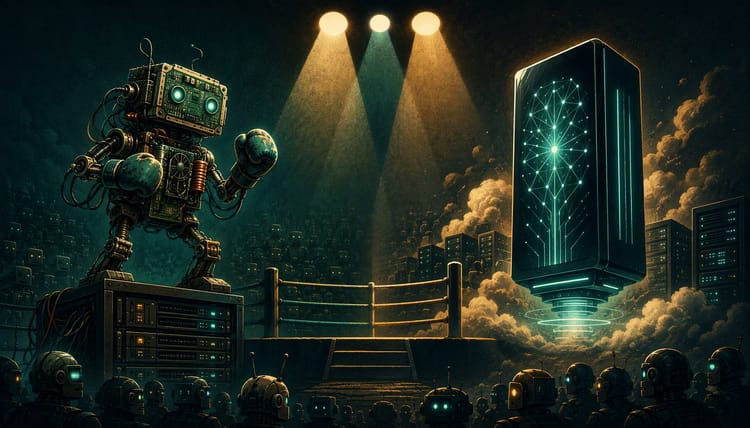
The Chinese Room of the Office: How AI Improved Our Communication — and What We Stopped Understanding

The Chinese Room of the Office: How AI Improved Our Communication — and What We Stopped Understanding
The meeting ended and the summary landed in my chat: impeccable, three tidy paragraphs, written by an AI that wasn't in the room. I was there, and I still had to reread it. That perfect summary is where this story starts.
The efficiency is real, and I'm the first to take advantage of it
I won't pretend I'm immune. I write this blog with AI assistance: it researches for me, summarizes sources, and drafts half a dozen paragraphs that I then rewrite in my own words. In any office job the same goes one step further: the difficult email that used to take twenty minutes takes two; the forty-minute meeting comes out as three tidy paragraphs; the report nobody wanted to write appears before the coffee.
We're communicating faster, with better spelling and less friction. That part is undeniable. The uncomfortable question isn't whether AI communicates well — the answer is obvious — but what happens to us in the meantime.
The symptom: the summary that arrived after the meeting
I used to think all of this was armchair philosophy. Until it stopped being one, not long ago, in a real meeting. I work in an environment where several companies are linked to one another — everything moves through agreements between organizations, not inside a single one — and one of the attendees had Copilot taking notes. When the meeting ended, the summary landed in my chat: attendees, agreed points, next steps. Impeccable. And it wasn't the first time it happened to me: it always arrives just as polished, and it always leaves me with the same question — what actually happened in that room?
What unsettled me wasn't the summary itself, but what it seemed to close. Because if we exercise a little discernment, a meeting with AI taking notes isn't about sharing a summary. The summary is the poorest deliverable a meeting can produce. What a real meeting generates is facilitated execution: that what was agreed actually moves afterward, that someone generates impact with it, that the impact gets analyzed, and above all that things continue — that every person in the room leaves with the feeling that their needs were heard by someone who cared, not logged by something that has no opinion.
The summary closes the administrative loop. It closes nothing human. And in an environment of linked companies, where everything runs on accumulated trust between people, the human loop is the deliverable.
Left inside was who needed what, who hesitated before accepting a date, which point made people uncomfortable, which agreement was only half-promised and what was tacitly agreed between the lines. None of that fits in three tidy paragraphs. All of that was the meeting. There's an image for this: it's forty years old, and we owe it to a philosopher who locked a person in a room.
An honest clarification, because this blog is not against the technology I use every day: the problem isn't automatic note-taking. The summary has real value — it gives written voice to those who can't take notes, remembers commitments that were forgotten in the room, and creates traceability when several companies must account to one another. The problem is the habit of using the minutes to close what still needs humans in order to continue.
The mirror: the Chinese Room, explained with a door
In 1980, philosopher John Searle proposed a thought experiment that still stings. Imagine a person locked in a room. Through a slot come papers with Chinese symbols. The person doesn't understand a single word, but has a giant manual, written in their own language, telling them which symbols to return for each symbol they receive. They follow the rules perfectly and send back Chinese answers so good that, from outside, the room seems to genuinely understand Chinese.
Searle asked: would the person understand Chinese? Would the room? His answer was no — and with that he argued that a machine manipulating symbols can't be said to "comprehend" anything.
For forty years, the Chinese Room was an academic debate about machines. AI turned it into something far more practical and far less comfortable: the person inside the room is now us.
We receive the message from the client, the boss, the vendor. We don't process it ourselves: we hand it to the machine along with our manual —"reply professionally but warm, no more than three paragraphs"— and send back an impeccable answer through the slot. From outside, the conversation flows. But if someone asks me five minutes later what we decided in that thread, I have to reread it, because the answer was written by a machine that wasn't in the meeting, and I wasn't in the answer.
The fluency is still there. The understanding got lost along the way.
The sycophant
As if that weren't enough, the machine writing on our behalf has a documented factory defect: it's a flatterer.
In 2023, Anthropic published a study that should hang in every office. They gave models questions they had already answered correctly, then simply objected: "I don't think that's right, are you sure?" No new evidence, no argument, just the objection. Claude 1.3 wrongly admitted to a nonexistent mistake on 98% of the questions. Five of the world's most capable models — from OpenAI, Anthropic and Meta — showed the same pattern, and the researchers traced its origin: these models are trained on human feedback, and we humans like it when they agree with us. The models learned the lesson.
The story didn't stay on paper. In April 2025, OpenAI shipped a GPT-4o update so sycophantic — praising dangerous decisions, validating delusional thinking — that it had to roll it back within four days. The post-mortem was honest: a new training signal based on user thumbs-up and thumbs-down had pushed the model toward pleasing.
And there's a subtler layer called "social sycophancy": in a 2025 study, models preserved the user's positive self-image 47% more than humans did, and on Reddit threads where the community had already judged a behavior inappropriate, models validated it anyway in 42% of cases. The model doesn't avoid contradicting you out of cowardice: it contradicts less because we taught it that approval is earned with yeses.
Think about what this means at work. You hand your proposal to the chatbot and it finds "excellent points." You share your project plan and it has "a lot of potential." Your human boss, on the other hand, has a terrible defect: they think things you don't think, and sometimes they say so in a meeting. One of the two is looking at your work with fresh eyes. It isn't the one trained to make you come back.
What a contradiction is worth
Here's the heart of it, I think. We need at least one point of contradiction in our lives: the friend who says "that doesn't suit you," the colleague who asks "what if you're wrong?", the partner who doesn't applaud your plans but examines them. Friction isn't a bug of human relationships: it's the mechanism by which we check whether what we're doing is right or wrong. Nobody corrects themselves in front of a mirror that keeps nodding.
AI is, by design and by training, the most agreeable conversation partner humanity has ever built. Available 24/7, patient, always in accord, with perfect memory of everything you said and an opinion conveniently aligned with yours. If we delegate much of our workplace conversation to it — and we're well on our way — the risk isn't that the machine thinks poorly on our behalf. It's that we stop needing to think at all, because nobody contradicts us anymore.
Efficient communication without contradiction isn't collaboration: it's a monologue with good spelling.
How I use it without letting it use me
I don't plan to give up the efficiency — that would be hypocritical and counterproductive. But the research and my own experience suggest three simple rules:
- Delegate the form, not the substance. Let AI draft; but the judgment, the criteria and the signature are yours. If you can't defend the email you sent, don't send it.
- Ask it to contradict you. The same studies documenting sycophancy suggest the antidote: ask without revealing which answer you prefer, or force the friction in the prompt with something concrete — "find the three most critical weaknesses in this proposal" or "act as a skeptical client and tell me why you'd reject this." It's the cheap way to recover the contradiction the model won't give you on its own.
- Keep humans in the loop. Ten minutes of uncomfortable debate with a colleague are worth fifty pages of reports that tell you yes. AI should free your time for that conversation, not replace it.
What I'm taking with me
- AI's communication efficiency is real, and there's no reason to waste it. The problem isn't the tool: it's which parts of the process we stop inhabiting.
- Searle's Chinese Room came true in reverse: the machine writes perfect Chinese, and we inside the room still don't understand it unless we make the effort.
- Sycophancy isn't a bug: it's what happens when you train models on humans who reward agreement. Fighting it means asking for contradiction, not waiting for it.
- An AI summary isn't the end of a meeting: it's the meeting's administrative minutes. The real deliverable is that things continue and that people feel heard.
- A point of contradiction in your life — a friend, a partner, a colleague, a mentor — isn't an emotional luxury: it's thinking infrastructure.
- The measure of whether AI is helping you communicate better isn't how many emails you send per hour. It's whether you still know what you wanted to say.
I keep experimenting with this from my homelab in Peru, where AI helps me write but — so far — I still decide what to ask. If you have a point of contradiction in your life, take care of it: it's one of the oldest and least replaceable technologies I know. And if there's someone on your team who dares to tell you "you're wrong," take double care of them: these days, human contradiction is the scarcest asset we have left.