From the Nike+ Human Race to a Coupon for Running 5K: How Nike Swapped a Creative for an Algorithm (and Lost $200B)

A race of a million people
On August 31, 2008, Nike staged the Nike+ Human Race: a 10K across 25 cities — Los Angeles, London, Paris, Shanghai, São Paulo among them — with a goal that sounded like marketing from another galaxy: one million runners on the same day. Everyone ran with a Nike+ iPod sensor or a SportBand, synced their kilometers to nikeplus.com, and got counted in the global race. Concerts in every city afterward. Over 750,000 people took part.
That was Nike in its creative era: technology in service of emotion. The sensor wasn't the product; it was the excuse to feel part of something. "Just Do It," connected.
The designer CEO
Mark Parker joined Nike in 1979 as a footwear designer and spent 14 years as CEO (2006–2020). Fast Company called him the most creative CEO of 2012. His office wasn't an executive floor: it was the Innovation Kitchen, the secret prototyping lab where Air, Free, the self-lacing HyperAdapt and the HTM projects with Tinker Hatfield were cooked up.
In his era, Nike's technology was always a means to culture:
- Nike+ iPod (2006): the first serious step toward personal telemetry for athletes, built with Apple.
- Nike+ Human Race (2008): the global race from above.
- FuelBand (2012): a wristband that turned movement into points — ahead of its time, discontinued in 2014, but it defined the wearable metric.
- Apps (NRC, NTC, SNKRS) and iPad-equipped stores: the coach, the community and the boutique in your pocket. In Nike's new-generation stores, associates served and checked out with iPads; customizing a pair was a ritual, not a transaction.
The logic was clear: athlete and story first, sale second. Data existed to know the runner, not to squeeze them.
The data CEO
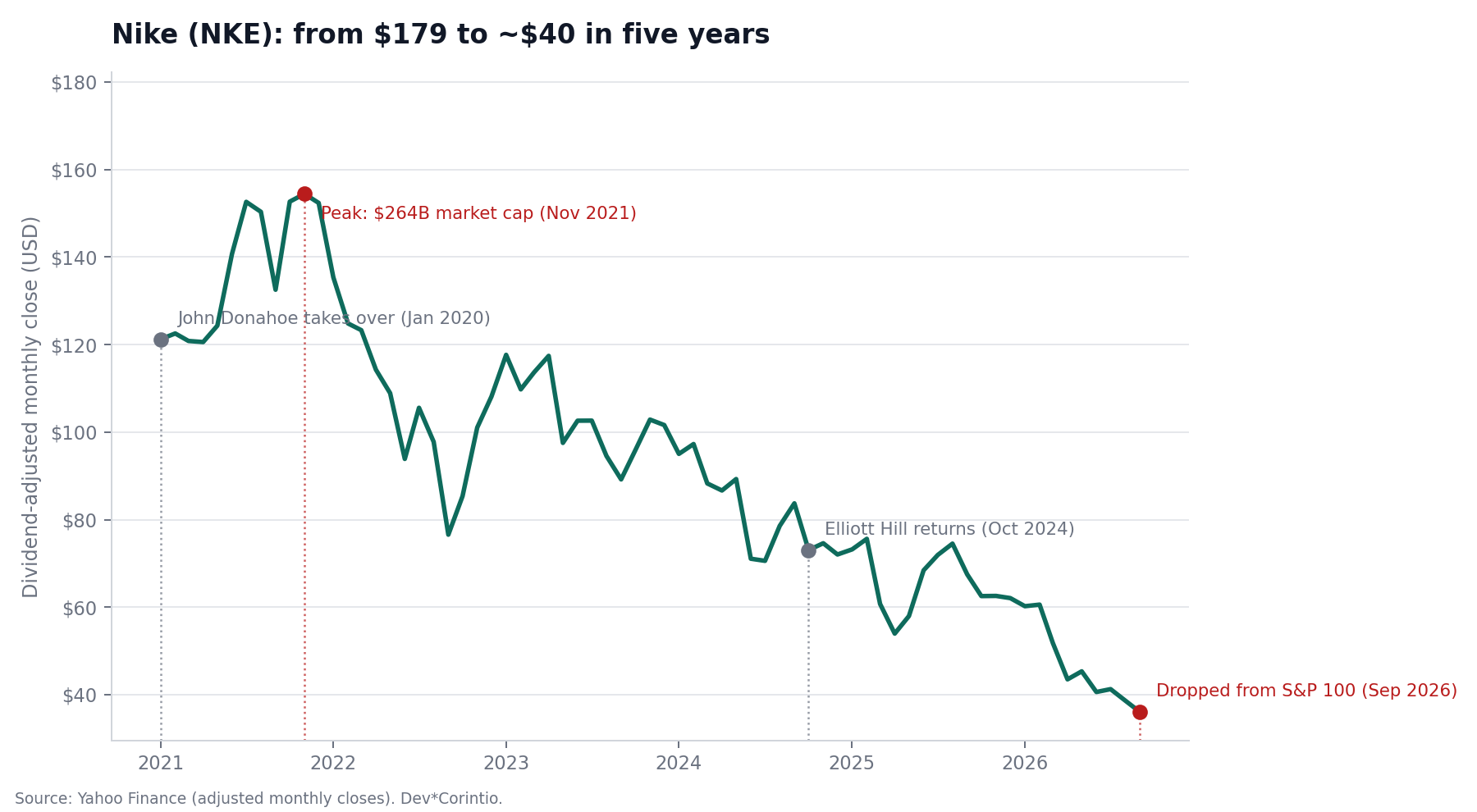
In January 2020, John Donahoe arrived: a Bain consultant, former CEO of eBay and ServiceNow. Zero years in footwear. His diagnosis was the one a consultant would make: "you're an inefficient retailer with an overvalued brand." His prescription, the Consumer Direct Acceleration:
- Goodbye wholesalers: cut ties with Foot Locker and friends to sell direct and keep the margin.
- Goodbye brand marketing: from culture-shaping campaigns to Google performance ads — everything measurable, everything clickable.
- Hello data: the athlete was now a cohort, a funnel, a conversion rate.
And here's the moment that sums up the whole era for me. In those years, opening the Nike app wasn't about finding the next Human Race: it was that, if you ran 5K, the app "celebrated" your effort... with a discount. The same sport that in 2008 made you part of a global story became, by 2023, a remarketing trigger. The emotional relationship became an automated transaction.
The bill
The numbers, no hype:
| Metric | Peak (2021) | Sep 2026 | Change |
|---|---|---|---|
| NKE share | $179.10 (Nov 2021) | ~$38–40 | −78% |
| Market cap | ~$264B | ~$57B | −$207B |
| S&P 100 | 18 years in | Out since Sep 21, 2026 | — |
| China | Growth engine | 8 consecutive declining quarters | — |
| Nike Direct (DTC) | Donahoe's "jewel" | −7% in the latest reported quarter | — |
Details that hurt:
- Leaving the S&P 100 isn't a delisting —Nike remains in the S&P 500— but it's symbolic: taking its seat were Dell, Palo Alto Networks, Arista and SanDisk. AI-infrastructure companies inherited the chair of the giant that wanted to become a data company.
- The styles Donahoe saturated —Air Jordan 1, Air Force 1, Dunk— spent years eaten by discounting, eroding exactly what DTC was supposed to protect: full price.
- Hoka and On ate the shelf space Nike gave away in wholesale.
The shoemaker returns (and the final irony)
In October 2024 Nike did the obvious: it called Elliott Hill, a 32-year company veteran, to undo the damage. He won Foot Locker back —which ended up starring its World Cup campaign "Rip the Script"—, stopped the product flooding and bet on performance running (five straight quarters of double-digit growth, +$1B in revenue). And yet the stock is still around $40: −56% since Hill arrived. Fixing a ship takes more than naming the right captain; in January 2026 he announced 775 distribution-center layoffs to speed up automation.
And here's the twist that I think is the real story: the company that traded creativity for data is now betting its future on AI... to buy creativity back.
- A.I.R. (Athlete Imagined Revolution): generative AI trained on elite athletes' data to co-create designs — from weeks to hours in prototypes.
- A proprietary LLM (a "private garden," per its chief innovation officer) trained on decades of biomechanical data no competitor can replicate.
- Nike Fit (AR that scans your feet), Flyprint (3D-printed soles), sensors and adaptive footwear.
In other words: Nike now uses AI for exactly what Mark Parker would have used any technology for —to design better and tell better stories. The difference is that along the way it burned $207B of market cap learning that data optimizes what already exists; it doesn't invent what nobody misses yet.
Lessons from my homelab
- Metrics measure the past. Optimizing your conversion funnel is running away forward: what you want is a product people want without a coupon. AI reminds me of this every time I "optimize" a prompt instead of asking whether the experiment was worth running.
- An owned channel doesn't replace a relationship. I self-host my services because I want control; but if I confused control with isolation, this blog would have zero readers and a great "conversion rate."
- Data-driven works better as a compass than as a map. Donahoe wasn't wrong to use data; he was wrong to let data decide what Nike was.
- The generative-AI irony: the companies that will use it best are the ones that never lost the creative instinct. AI amplifies what you bring; it doesn't replace it. In 2008 Nike already knew that. It just had to lose $207B to remember.
Primary sources: Fortune, Reuters, CNBC, Yahoo Finance, Nike IR historical releases. Figures as of Sep 24, 2026. Not investment advice: a chronicle of what happens when the metric eats the message.